Artist Statement
Fantasy for the Sake of Reality
My work is populated by strange humanoid creatures made up of elements from nature. These beings are created through an understanding of the cultural and historical symbolism of certain plants or animals. Since different species are associated with different meanings they become a mechanism to explore real world issues. Often, these are: identity, colonialism, discourse and migration, as connected to Ecuador and Latin America.
Because my style is aesthetically akin to fables and dreams rather than photorealistic denunciations of the real, the result is a more emotional portrayal of the issues affecting my community. My paintings are not shocking, rather their goal is to invite the viewer to look closer at the creepy details within. They challenge stereotypical visuals of conflict, as presented by news outlets. Our modern constant exposition to violent imagery fails at generating empathy, it rather numbs us to the pain of others. Simone Weil, in her essay on war The Iliad, or The Poem of Force (1940) states that “force - it is that x that turns anybody who is subjected to it into a thing. Exercised to the limit, it turns man into a thing in the most literal sense: it makes a corpse out of him”. Following this logic, I challenge literal depictions of tragedy so as not to further objectify those subjected to it.
So, the overall goal of my work is to tackle difficult subjects related to my community in a way that triggers contemplation through visual storytelling and thus propels a complex emotional acknowledgement of reality.
Plantain People
Amongst the more recurrent creatures in my work there is, for instance, plantain-people. This came from considering the term "banana republic", an expression meant to refer to the political instability and chaos of South American nations. In the early twentieth century, massive foreign corporations established banana plantations in the continent. To benefit them, local democratic governments were overthrown and dictatorships that served their ambitions were installed. Plantains thus, become a token of a history of colonialism and foreign interventions. A humanoid plantain represents the people whose lives are entrenched with this history.
Vampire Orchids
Also, a particular endemic orchid from Ecuador called ‘dracula vampira’ to represent corruption. They are an epiphytic species, they grow on top of other plants and extend their roots around them. Unlike the people they are meant to represent, they are not really parasitic. However, their scientific name, as they are part of the Dracula genus, and their appearance gives them the qualities to visually represent villainous forces. Their petals have dark purple veins and its center features a pink piece that looks like a smiling mouth. This vampiric flower makes for a sharp metaphor of the powerful sustaining their stature through exploitation. The orchid genus Dracula consists of more than a hundred species native to Ecuador, Peru, Colombia, Central America and Mexico.
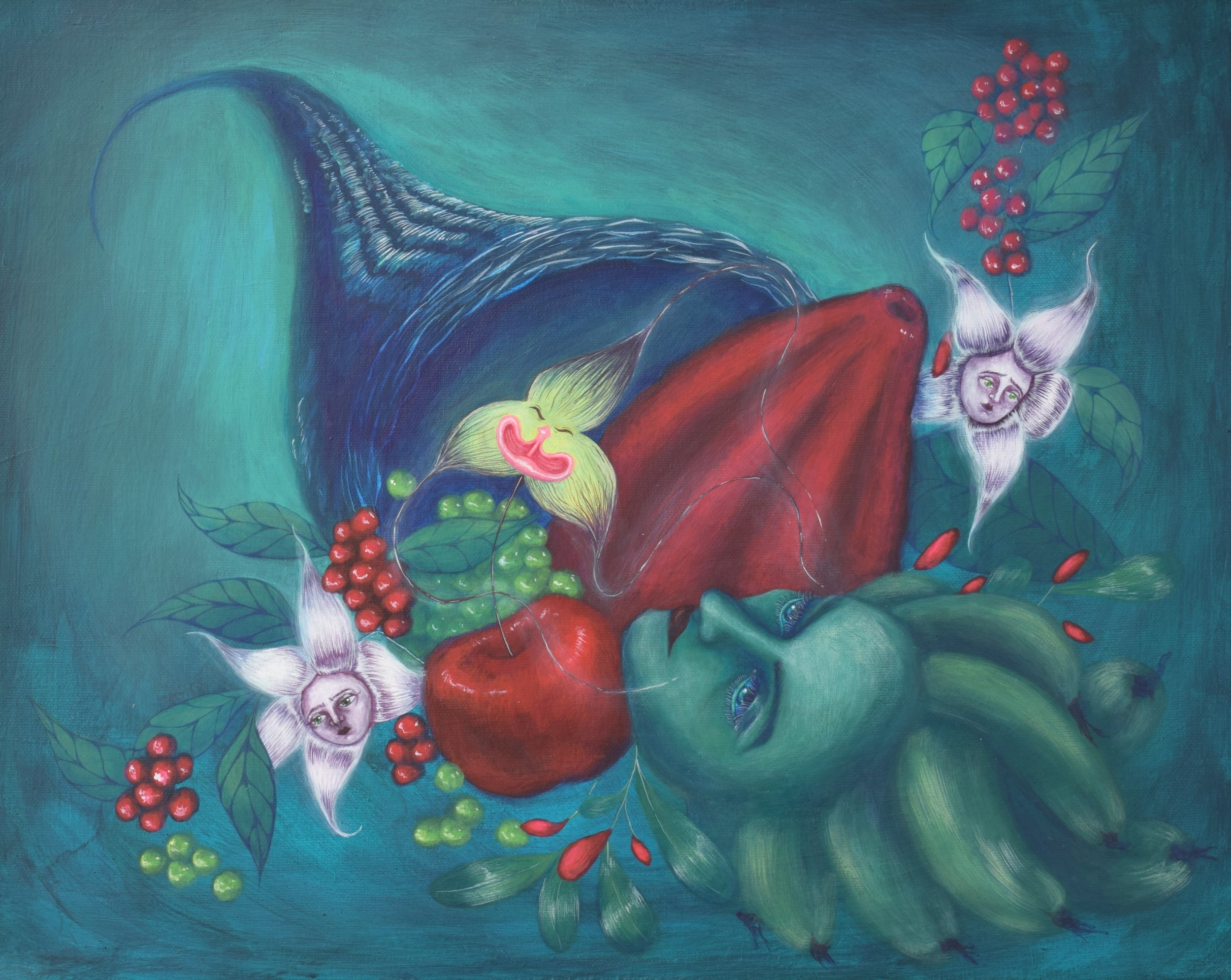
Cornucopia or to live poor on a rich land,
acrylic on canvas, 40x50cm, 2026